Scanning in the Dark: Solving Pitch-Black Reality Capture Aboard the SS United States
When you’re tasked with capturing a digital twin of the world’s fastest ocean liner before she’s repurposed as the world’s largest artificial reef, you expect a few technical hurdles. But scanning the historic SS United States presented a very specific reality capture challenge: capturing intricate structural detail in near-total darkness.
Before a vessel is sunk to create an artificial reef (following strict guidelines like the EPA Vessel-to-Reef Best Management Practices), it must be meticulously stripped. Hazardous materials, wiring, loose equipment, and—crucially—all onboard lighting are completely removed.
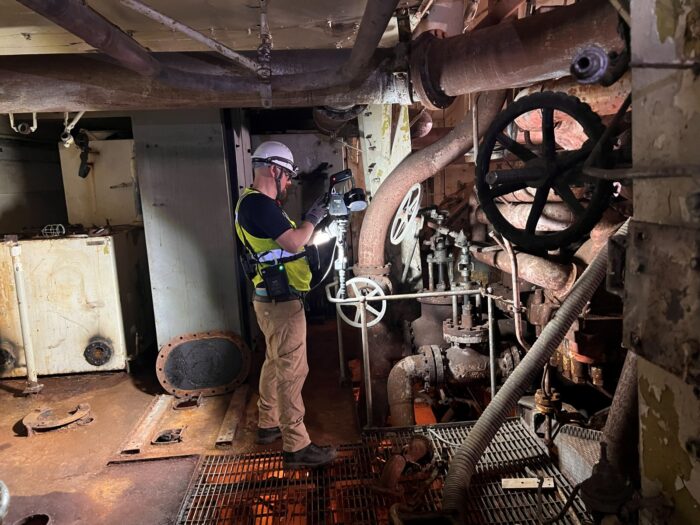
While upper decks offered natural daylight spilling through removed portholes and doorways, the lower decks were an entirely different story. Down below, we were operating in pitch-black, cavernous steel compartments with zero ambient light and no onboard power.
The Tech Challenge: Mobile Scanning in Zero Light
Setting up stationary work lights across thousands of square feet of dark, labyrinthine decks would have crippled our field efficiency and created significant safety hazards.
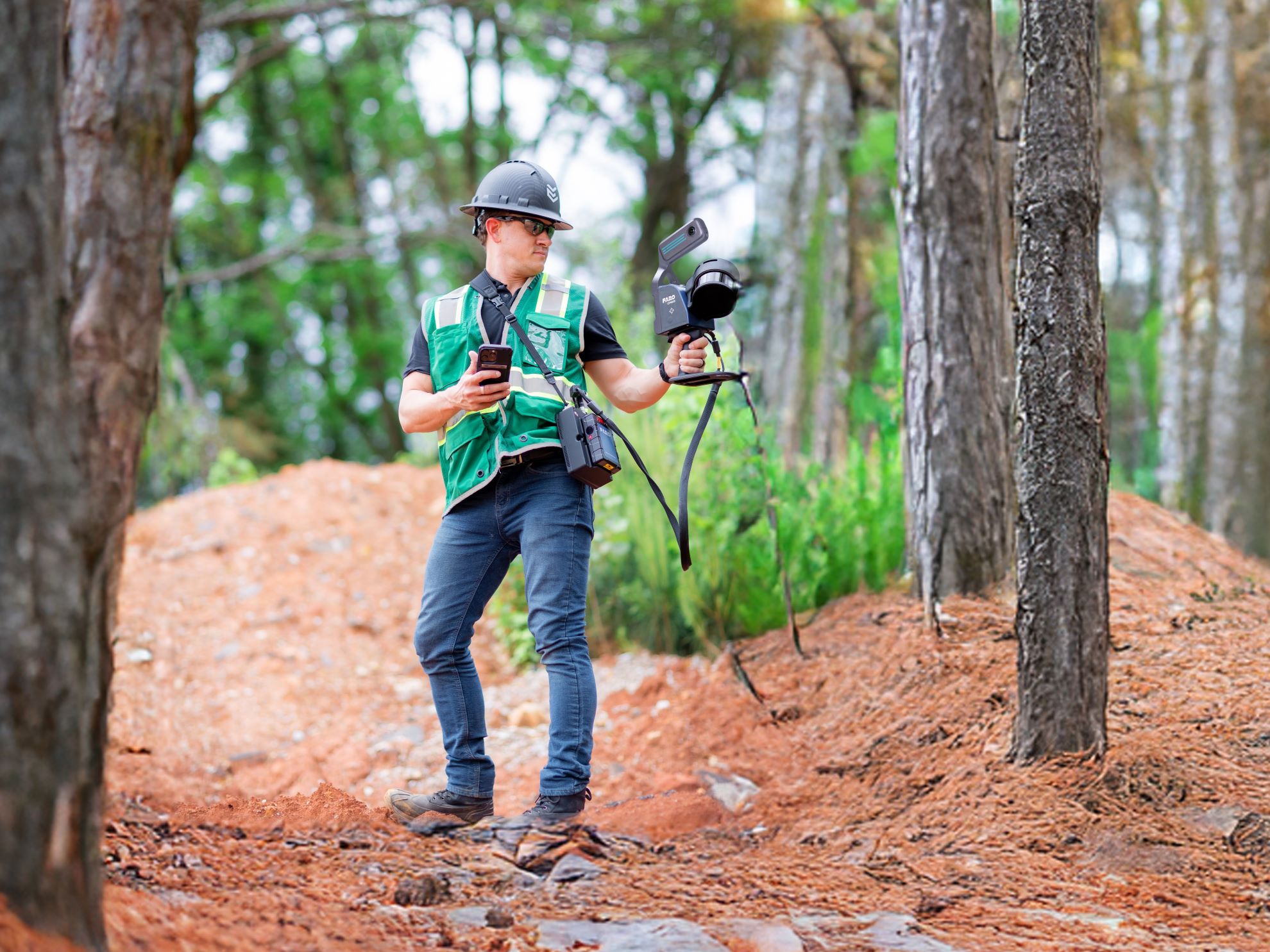
To maximize field speed, our team deployed the FARO Orbis Premium. The Orbis excels at rapid, high-accuracy SLAM capture on the move, but mobile scanning in total darkness presents a unique problem: the camera sensors and visual SLAM rely on light to track effectively and capture colorized point clouds.
To keep our team moving at the pace the FARO Orbis allows, we needed a continuous, mobile light source.
We adapted a technique we originally developed for above-ceiling plenum space capture:
- The Inspiration: For above-ceiling work, we attach compact, high-lumen LED light panels directly to our scanner mounts, illuminating tight plenum spaces as the scanner extends above the ceiling grid.
- The Adaptation: For the lower decks of the SS United States, we took that concept mobile. Our operators donned custom body harnesses integrated with the same high-lumen LED panels, casting a constant field of bright light directly in the direction of travel.
- The Result: Dynamic scene illumination. By pairing the mobile capture capabilities of the FARO Orbis Premium with hands-free body lighting, our team safely navigated pitch-black spaces, maintained visual SLAM tracking, and captured crisp point clouds without stopping to relocate static tripods.
Preserving History in the Cloud
By adapting our toolkit to the environment, our team safely completed the high-resolution Phase II scan—capturing the architectural legacy of “America’s Flagship” before her final voyage to the bottom of the Gulf of Mexico.
While the physical ship will soon begin its second life building vibrant marine ecosystems off Okaloosa County, Florida, her engineering marvels are now permanently preserved in the cloud.
Tags: Scan-to-BIM, Sphere® XGCategorized in: Articles
This post was written by Soniel San Pedro